Camera comparison
Hikvision vs Reolink: Which Cameras for a Home NVR?
Compare Hikvision and Reolink for a home NVR: product range, RTSP and ONVIF support, firmware experience, NDAA context, and which fits an Apple-based system.
Two brands, two sales models
Hikvision is one of the world's largest video surveillance manufacturers. Its catalog spans entry-level cameras through specialized professional equipment—varifocal lenses, long-range zoom, thermal imaging, license-plate capture—plus its own recorders and management software. Products reach most buyers through distribution and installer channels, and the lineup is split into regional and market-specific product lines whose menus, defaults, and firmware can differ for what looks like the same camera.
Reolink is a consumer- and prosumer-focused brand sold directly through its own store and online marketplaces. The lineup is smaller and easier to navigate: PoE and Wi-Fi cameras, battery models, doorbells, kits, recorders, and the Home Hub. Price positioning reflects the channels—Hikvision stretches from budget lines to specialized professional gear, while Reolink concentrates on the value-oriented consumer and prosumer tier. Neither brand publishes a single worldwide price list, so compare specific models in your market.
RTSP and ONVIF support compared
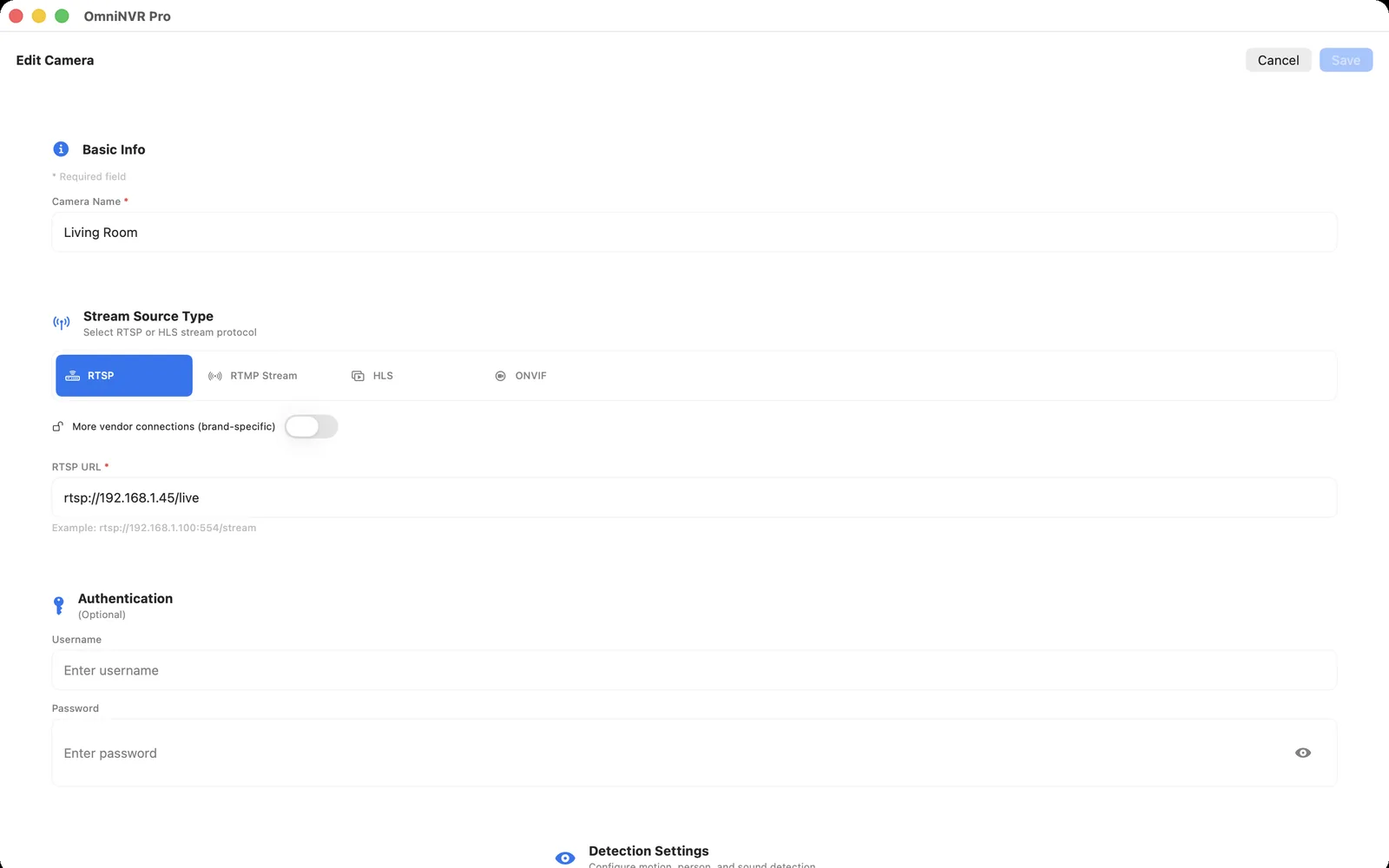
Both brands broadly support the standards a third-party NVR needs, with model-specific exceptions. Hikvision cameras and recorders commonly expose RTSP with the /Streaming/Channels/101 path pattern and support ONVIF after you create a dedicated ONVIF user in the device interface. Reolink's wired PoE and plug-in Wi-Fi cameras commonly use /h264Preview_01_main and _sub paths once RTSP and ONVIF are enabled in settings.
Reolink's exceptions matter for planning. Its battery-powered cameras do not support RTSP, ONVIF, or similar protocols as standalone devices—Reolink states this is a hardware limitation—though many gain third-party access when paired with a Reolink Home Hub or NVR. The base E1 indoor camera lacks RTSP while E1 Pro-class siblings offer it, and 4G LTE models are not supported at all. Hikvision's exceptions are more about variation than absence: menu names, default settings, and available services differ across firmware versions and regional lines, so verify the exact model either way.
Side-by-side comparison
| Factor | Hikvision | Reolink |
|---|---|---|
| Product range | Very large: entry-level to specialized professional lines, plus recorders and VMS | Focused consumer and prosumer lineup: PoE, Wi-Fi, battery, doorbells, kits, hubs |
| Sales channel | Primarily distributors and professional installers; regional product lines | Direct retail and online marketplaces; largely uniform lineup |
| RTSP support | Broad across cameras and recorder channels; /Streaming/Channels/101-style paths | Broad on wired models; standalone battery, base E1, and 4G LTE models excluded |
| ONVIF support | Common; usually requires creating an ONVIF user in the device interface | Common on wired models; enabled alongside RTSP in network settings |
| Known limitations | Firmware and menus vary by region; U.S. federal procurement restrictions apply | Battery cameras need a Home Hub for third-party protocols; model matrix must be checked |
| Best fit | Installer-grade projects needing specialized models or recorder integration | Self-installed home and small-business systems bought at retail |
Treat the table as a starting point, not a verdict. Within each brand, support is model- and firmware-specific, and both publish documentation that is worth reading for the exact camera you plan to buy.
Firmware, apps, and regulatory context
The day-to-day experience differs more than the protocols do. Hikvision assumes a professional workflow: a full web interface, desktop management software, and many configuration layers, which is powerful but has a steeper learning curve, and firmware updates can be split across regional support sites. Reolink centers on its consumer app and desktop client, with simpler menus and a more uniform update path—less granular control, but easier self-service setup.
Regulatory context is a factual consideration in some markets. Section 889 of the U.S. National Defense Authorization Act for fiscal year 2019 prohibits federal agencies from procuring video surveillance equipment from several named manufacturers, including Hikvision, and since August 2020 the restriction extends to contractors using covered equipment. The FCC has also placed Hikvision on its Covered List and in November 2022 adopted rules restricting new equipment authorizations for covered equipment. These rules govern U.S. federal procurement, federally funded projects, and equipment authorization; they do not prohibit private home use. Reolink is not named on the FCC Covered List. Requirements differ by country and change over time, so buyers with compliance obligations should check the current lists directly.
Which should you choose for an Apple-based local NVR?
For an OmniNVR system, Mac, iPhone, iPad, and Apple TV can all record locally. Choose the device by the recording mode, storage option, background behavior, and review interface available in its released app; Apple TV specifically supports manual local recording and event history. Either camera brand can fit when the exact model exposes a compatible RTSP or ONVIF service. Choose Hikvision when you want the widest hardware selection—specialty lenses, higher-end sensors, recorder integration—and are comfortable with installer-grade configuration, or when an installer is doing the work. Choose Reolink when you want to buy at retail, set cameras up yourself, and keep the system simple.
Whichever brand you pick, the same rules apply: prefer wired or continuously powered models for 24/7 recording, confirm RTSP and ONVIF support for the exact model and firmware before purchase, use dual streams where the selected app supports that policy, and test live view, a short recording, and a reconnect before scaling up. A software NVR that records over open standards can also mix both brands in one system, which keeps future purchases flexible.
Frequently asked questions
Do Hikvision and Reolink cameras both work with OmniNVR?
Yes, when the exact model exposes a compatible RTSP, RTSPS, ONVIF, or HLS stream. Support varies by model, region, and firmware on both brands, so verify the specific camera and test a short recording before committing.
Is Reolink affected by the NDAA restrictions that cover Hikvision?
NDAA Section 889 names Hikvision among manufacturers barred from U.S. federal procurement, and Hikvision also appears on the FCC Covered List; Reolink is not named on that list. These rules apply to federal purchasers, contractors, and funded projects rather than private home users, and current lists should be checked for compliance work.
Do Reolink battery cameras support RTSP or ONVIF?
Not as standalone devices—Reolink states battery models lack the hardware support for those protocols. Many battery cameras gain third-party access when paired with a Reolink Home Hub or NVR, so check Reolink's model support matrix.
Which brand is easier to set up for a home NVR?
Reolink generally, because it is designed for retail self-installation with a simpler app and uniform firmware. Hikvision offers more configuration depth but assumes more networking knowledge and often an installer channel.
Can I mix Hikvision and Reolink cameras in one NVR?
Yes. A software NVR that records over RTSP and ONVIF treats each camera as an independent standards-based source, so both brands can share one live wall, timeline, and storage policy.
Sources and further reading
Record locally on the Apple device that fits the job.
Mac, iPhone, iPad, and Apple TV all support local recording. Recording modes and storage options can differ by platform and app version.