ONVIF
ONVIF Profiles for NVR Software: S vs T vs G vs M
Compare ONVIF Profiles S, T, G, and M for NVR software, verify exact camera firmware, and choose the profile that matches streaming, storage, or analytics needs.
Profile S, T, G, and M at a glance
| Profile | Main NVR use | What to verify |
|---|---|---|
| S | Basic IP video streaming | Legacy authentication, codec, audio, PTZ, and exact firmware |
| T | Advanced streaming, H.264/H.265, events, metadata, and stronger authentication paths | Client and device conformance plus conditional features |
| G | Edge storage, search, retrieval, and replay | Whether the camera or recorder exposes the required recording services |
| M | Analytics metadata and event exchange | Which event types, object classes, and metadata streams are implemented |
Profiles are complementary. A camera can appear in more than one row, and the feature you need may be mandatory for a client but conditional for a device. Use the profile feature overview and the exact product's declaration rather than treating “ONVIF compatible” as a complete specification.
Prefer Profile T for new streaming purchases
ONVIF describes Profile T as the successor to Profile S for advanced video streaming. Profile T adds current streaming capabilities including H.264 and H.265 coverage, metadata, events, bidirectional audio paths, and authentication options that avoid relying on the older username-token mechanism.
Profile S products do not stop working merely because Profile S is being deprecated. Existing declarations remain associated with the registered firmware. For a new purchase, however, start by checking Profile T and the exact features needed by your NVR, then retain Profile S only when legacy interoperability requires it.
Understand what Profiles G and M do not mean
Profile G concerns recording and retrieval services on a device or client with storage capabilities. It is relevant when an NVR must search or replay video stored at the camera edge. It does not mean that an ordinary Profile T camera automatically exposes an NVR-like archive.
Profile M standardizes metadata and events for analytics applications. It can help systems exchange object or event information, but it does not guarantee that a specific camera detects every object class or that an NVR presents those events in its interface. Verify the producer, consumer, and event vocabulary together.
Verify conformance by exact firmware
- Record the manufacturer, full model identifier, region, and installed firmware.
- Search the ONVIF Conformant Products database for that exact product and software or firmware version.
- Open its declaration and feature list; confirm the profile and the specific mandatory or conditional feature you need.
- Confirm that the NVR client supports the matching service and feature.
- Test live video, recording, playback, events, audio, and PTZ as separate acceptance items.
ONVIF states that its Conformant Products database is the authoritative list. A logo on a marketplace listing, vendor membership, or a discovery response alone is not equivalent to a registered conformance record.
Translate profiles into an NVR buying checklist
- Live and recorded video: begin with Profile T or a documented RTSP stream and verify the actual codec.
- Legacy camera fleet: inventory Profile S authentication and codec dependencies before changing firmware.
- Camera-side storage: require the Profile G operations used by the intended replay workflow.
- Analytics events: map Profile M metadata to the event types the NVR can store and display.
- PTZ and audio: test them explicitly because device-side support can be conditional.
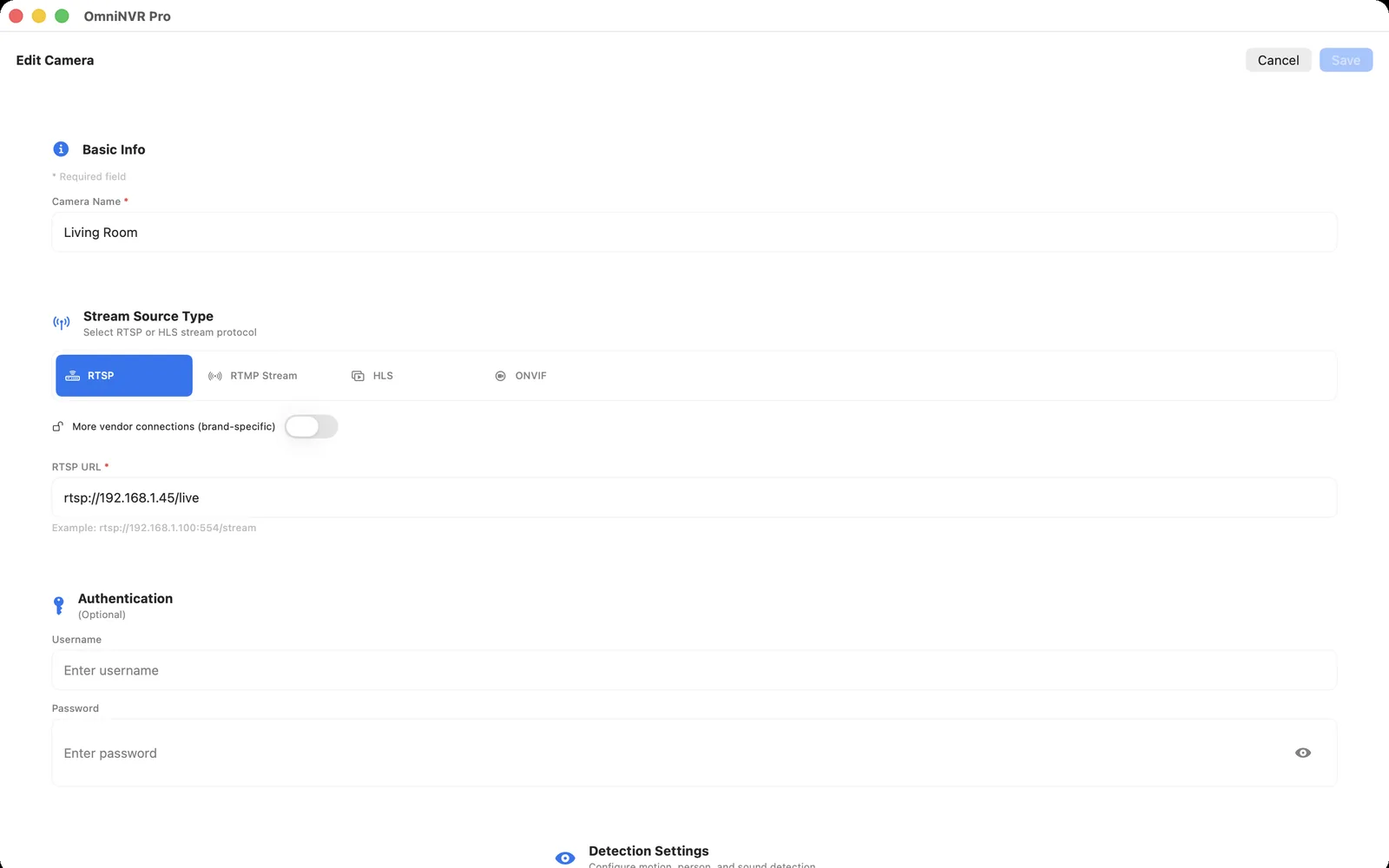
OmniNVR platform apps can use supported camera services, but discovery and control options differ by released build. Product support should not be described as formal ONVIF profile conformance unless the exact software version appears in ONVIF's official database.
Frequently asked questions
Is ONVIF Profile T better than Profile S for a new camera?
Profile T is the advanced-streaming successor and is the better starting point for a new purchase. Still verify the exact camera firmware, NVR client, codec, authentication, and conditional features.
Does Profile G mean the camera is an NVR?
No. Profile G defines interoperable edge recording, search, retrieval, and replay functions. The product still needs suitable storage and the specific services used by the client.
Can a product be ONVIF compatible without being officially conformant?
A product may implement ONVIF-related services, but ONVIF says official conformance is established by the exact model and firmware entry in its Conformant Products database.
Sources and further reading
Record locally on the Apple device that fits the job.
Mac, iPhone, iPad, and Apple TV all support local recording. Recording modes and storage options can differ by platform and app version.