2026 NVR software selection
Best Privacy-First NVR Software in 2026
Evaluate private NVR software by local processing, credential storage, account scope, network exposure, retention, export, and optional integrations.
The short answer
A privacy-first NVR minimizes collection and exposure, records only authorized views, protects camera credentials, documents who can review footage, and deletes recordings on a deliberate schedule.
Start with the job and failure modes, then compare products. For privacy-sensitive local camera recording, the minimum useful shortlist must cover purposeful camera placement, local or intentionally chosen storage, least-privilege accounts, private network services, retention controls, access revocation, and an auditable export process. A product that cannot pass those checks should not advance because of a large camera-count claim or a fashionable feature.
Build a requirement-led shortlist
Separate must-have requirements from preferences. Record the host platform, exact camera models and firmware, stream protocols, codecs, camera count, continuous or event policy, retention days, storage location, authorized users, remote-access boundary, and the time available for maintenance.
Local storage is only one privacy control. Audio, neighboring views, shared device accounts, cloud notifications, backups, and exported clips can create separate obligations.
Verify camera and recorder compatibility
Use the exact camera, not a brand-level promise. RTSP can provide the direct media session; ONVIF can help with discovery, profiles, time, PTZ, and events when both client and device support the same functions. Neither label proves recording, retention, timeline, or export quality.
Test one camera through authentication, live view, multiple recorded segments, playback, a network interruption, a host restart, and a storage cleanup cycle before buying or migrating the rest.
Where OmniNVR fits
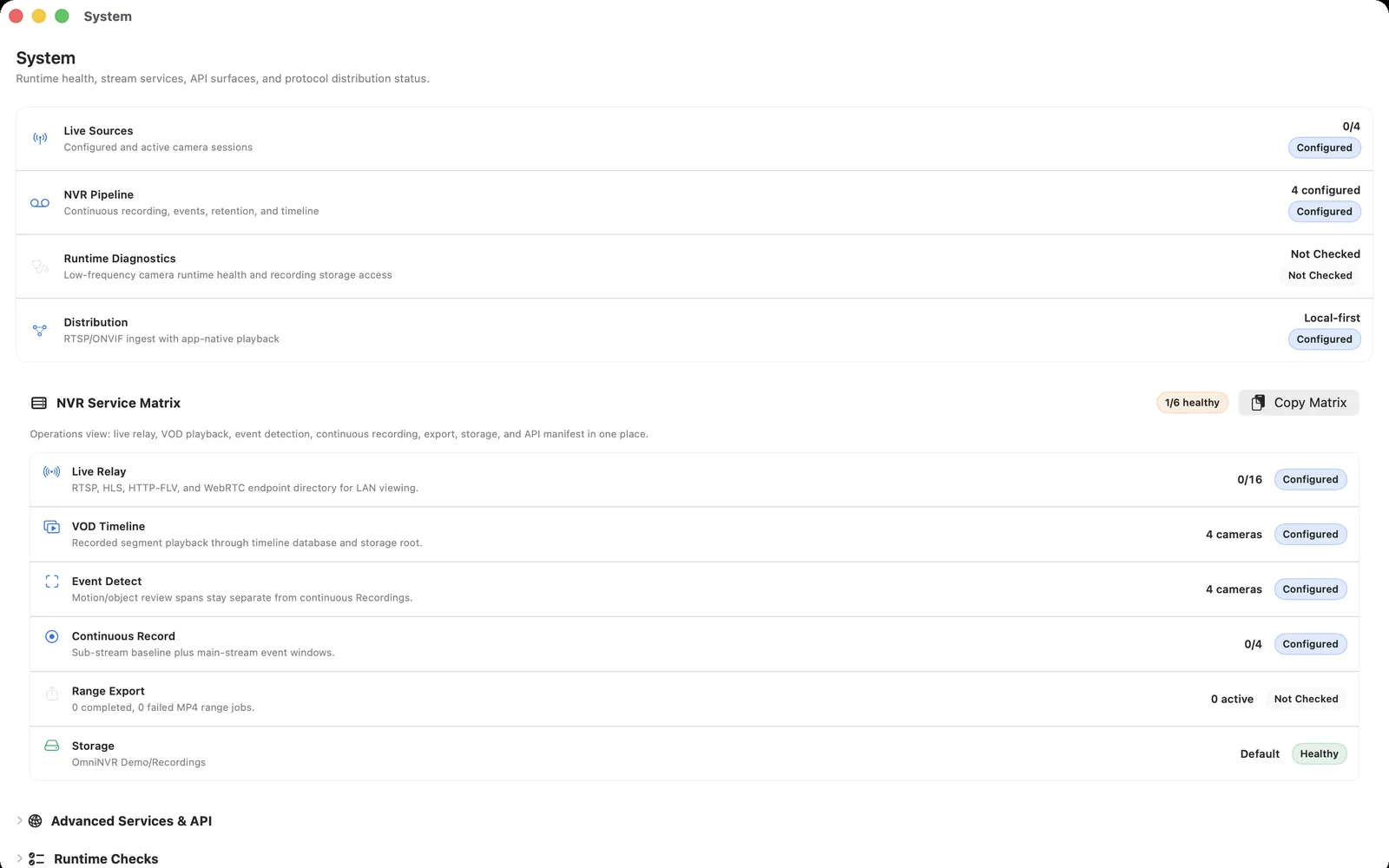
OmniNVR is local-first on supported Apple platforms, with recordings stored on the location selected for that platform and credentials protected with Apple Keychain where supported. Optional integrations should be enabled only when their data path is understood.
Compare current platform roles on the OmniNVR platform facts page. Mac, iPhone, iPad, and Apple TV can all record locally, but recording modes, storage options, and review tools can differ by platform and app version. Do not infer feature parity.
Run a fair 2026 acceptance test
Map every data path, disable optional integrations, review account access, export one clip, delete it through the retention process, and confirm no camera service is exposed directly to the internet.
Document the result, camera firmware, stream profile, codec, bitrate, storage destination, app version, and any optional service. Repeat the test after the first meaningful update. The best software is the option that remains understandable after normal change, not merely the one that looked easiest during initial setup.
Frequently asked questions
What is the best privacy-first nvr software in 2026?
A privacy-first NVR minimizes collection and exposure, records only authorized views, protects camera credentials, documents who can review footage, and deletes recordings on a deliberate schedule. OmniNVR is one candidate when compatible cameras and supported Apple devices fit; compare other products when Windows depth, self-hosted AI, NAS recording, or enterprise VMS operation is required.
Does ONVIF guarantee that every camera feature works?
No. Verify the exact registered profile and test media, authentication, events, audio, PTZ, time, recording, and recovery with the precise camera and firmware.
Can NVR software work without the internet?
The local camera, network, recorder, and storage path can operate without the internet when the product and cameras support it. Installation, licensing, updates, notifications, or optional remote services may have separate requirements.
How should I test NVR software before buying?
Map every data path, disable optional integrations, review account access, export one clip, delete it through the retention process, and confirm no camera service is exposed directly to the internet.
Sources and further reading
Record locally on the Apple device that fits the job.
Mac, iPhone, iPad, and Apple TV all support local recording. Recording modes and storage options can differ by platform and app version.