Education and community NVR use case
Daycare exterior and entry: A Practical Local NVR Plan for U.S. Users
Plan daycare exterior and entry with local NVR recording, camera placement, storage, recovery, privacy, and secure remote access for a U.S. site.
Define the decision the video must support
The purpose is not to install the largest possible camera system. It is to help schools, libraries, faith communities, nonprofits, and youth-program operators answer a narrow question after a real event. For daycare exterior and entry, the evidence path is parking arrival, controlled entrance, pickup queue, and exterior play-yard gate without filming private care spaces. Write that sentence before buying cameras; it determines where the view starts and ends.
Then name the event that should be easy to find: authorized pickup, door activity, exterior safety incident, or after-hours entry. An event marker can speed up review, but it should not be treated as proof that every relevant moment was detected. Keep enough surrounding context to show what happened before and after the trigger.
Place cameras and prove the local stream
Prioritize controlled entrances, public circulation, and exterior arrival areas while excluding counseling, health, restroom, changing, and other sensitive spaces. Walk the site at the busiest and darkest times. Check faces or objects at the distance that matters, backlight, glare, moving obstructions, weather, and whether a camera can be reached for maintenance.
Before final mounting, confirm that each exact model and firmware exposes a supported local stream. RTSP can provide the direct video input; ONVIF may help with discovery and profile selection. Test the real credentials, codec, main or sub stream, clock, and sustained playback in the intended NVR.
Choose recording, storage, and retention
Continuous recording at entrances preserves context; use event bookmarks for door activity or after-hours motion and restrict who can export clips. Estimate storage from measured bitrate rather than resolution alone. For a first design, four to sixteen cameras may be enough, but the required views and evidence quality should set the final count.
Set the shortest documented retention window that meets safety, incident-review, records, insurance, and institutional requirements. Add free-space headroom and confirm that cleanup deletes the oldest eligible segments before the disk fills. A retention promise is only real when an operator can find and play the oldest expected recording.
Test review, export, and recovery
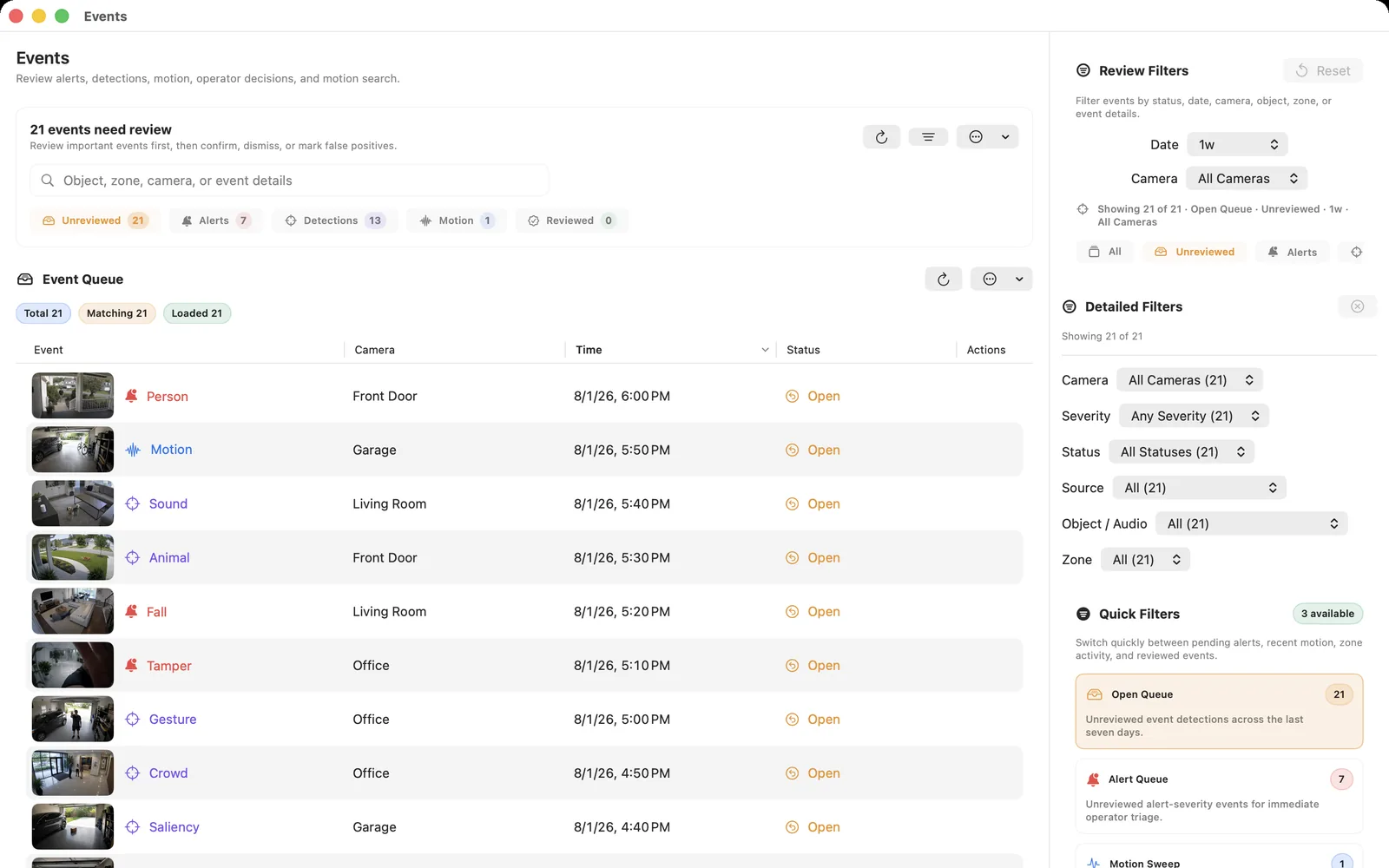
Run a staged incident instead of accepting a live preview. For this site, test pickup rush, child-height visibility, parent access requests, and written retention and export rules. Open the timeline from another authorized account, follow the event across the necessary cameras, and export a bounded clip with the correct time and camera names.
Restart the recorder and one camera during a planned window. Confirm automatic reconnection, a new playable segment, sensible timestamps, and visible offline status. Repeat the test after any firmware, camera-profile, storage, network, or time-zone change.
Set U.S. privacy and security boundaries
Student or youth video can become a protected record depending on how it is used and maintained. Apply FERPA and other rules case by case with the institution's privacy lead. U.S. federal, state, local, sector, lease, labor, and contract rules can apply differently, so this guide is an engineering plan rather than legal advice. Document the purpose, field of view, retention, access roles, export process, and deletion process before recording begins.
Use unique credentials, supported firmware, least-privilege accounts, and encrypted remote access. Keep camera administration, RTSP, and ONVIF off the public internet. Review account access periodically and remove installers, contractors, volunteers, staff, or household guests when their role ends.
Frequently asked questions
How many cameras are needed for daycare exterior and entry?
Start with the fewest fixed views that can show parking arrival, controlled entrance, pickup queue, and exterior play-yard gate without filming private care spaces. That is often four to sixteen cameras, but a field test—not the building size or a vendor bundle—should set the final count.
Should this NVR record continuously or only on events?
Continuous recording at entrances preserves context; use event bookmarks for door activity or after-hours motion and restrict who can export clips. If event-only recording is used, test missed detections, pre-roll, post-roll, and recovery so a marker does not create an unexplained gap.
How much storage and retention are appropriate?
Set the shortest documented retention window that meets safety, incident-review, records, insurance, and institutional requirements. Measure the sustained bitrate of every recorded stream, calculate daily capacity, add safety headroom, and verify the oldest expected footage in the timeline.
Can the cameras be viewed remotely?
Yes, through an authenticated and encrypted access design. Do not forward camera management, RTSP, or ONVIF ports directly to the public internet, and give each viewer only the permissions required.
Is camera recording legal for daycare exterior and entry?
The answer depends on the exact location, field of view, audio setting, people recorded, purpose, notice, access, retention, and applicable federal, state, local, sector, lease, labor, and contract rules. Obtain qualified local advice for the finished design.
Sources and further reading
Record locally on the Apple device that fits the job.
Mac, iPhone, iPad, and Apple TV all support local recording. Recording modes and storage options can differ by platform and app version.