Camera setup
eufy NVR and RTSP Setup: S4 Max, HomeBase and Compatible Cameras
Understand the eufy S4 Max PoE NVR, HomeBase, model-specific NAS/RTSP support, and when a powered eufy camera can connect to OmniNVR.
Compatibility is model- and firmware-specific. OmniNVR and TardisLabs are not affiliated with or endorsed by eufy Security.
Check compatibility before you start
The eufy PoE NVR Security System S4 Max is a dedicated eufy camera-and-recorder system. Its official overview describes continuous recording, local AI, included storage, and multi-camera expansion. That product page does not by itself establish that the recorder or every bundled camera exposes a generic RTSP or ONVIF endpoint to third-party NVR software. Verify the current manual and exact released firmware before planning an OmniNVR connection.
For other eufy cameras, open the eufy Security app, select the camera, and look for NAS (RTSP) in storage or general settings. If the option is absent after updating firmware and the app, treat the model as unsupported rather than borrowing a URL from another eufy camera. Battery cameras, SoloCam products, and HomeBase workflows can have additional wake-up and stream limitations.
When NAS/RTSP exists, enable it only on a trusted local network and create the credentials requested by the app.
Add the camera or NVR channel
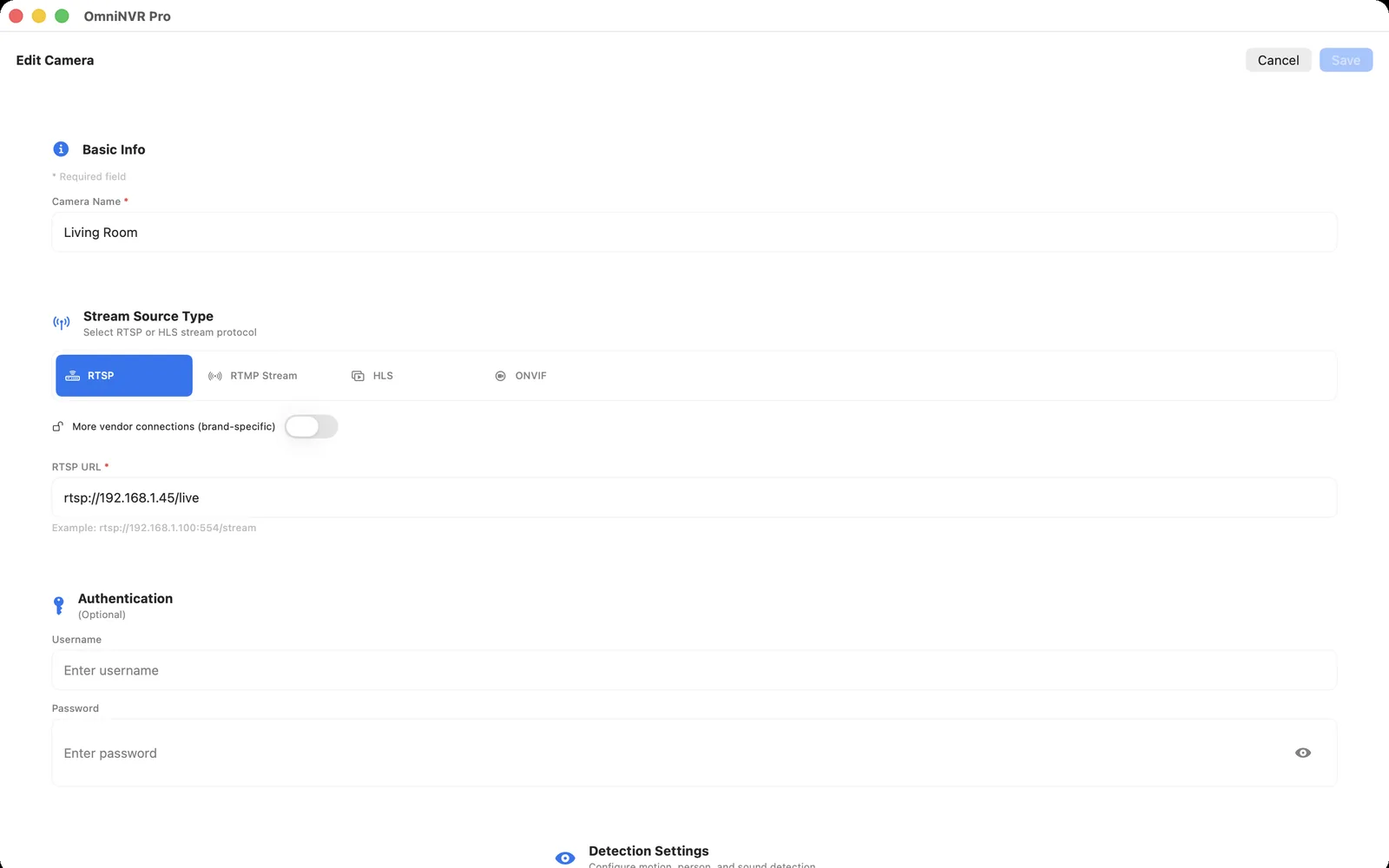
Copy the RTSP address shown by the eufy app and enter it in OmniNVR with credentials stored separately. Because the app-generated path can vary, it is more reliable than a third-party list. Test whether the stream remains available for at least fifteen minutes before enabling continuous recording.
If only one stream is exposed, choose a bitrate that the host can record continuously. If both qualities are available, use the lower one for baseline retention.
Choose recording roles
Use the lower-bitrate sub stream for continuous history when it has enough detail, and reserve the main stream for focused live view or event clips. This reduces storage and decode load without giving up high-quality evidence around important moments.
Before scaling up, record one camera for at least fifteen minutes, play it from the timeline, disconnect the network briefly, and restart OmniNVR. A working live preview alone does not prove that timestamps, recovery, and storage are reliable.
Troubleshooting checklist
- S4 Max works in the eufy app but not a third-party NVR: an integrated eufy recording workflow is not proof of a generic RTSP or ONVIF export.
- NAS option missing: the model or operating mode may not support generic RTSP.
- Stream sleeps: battery-saving behavior can conflict with a recorder's always-open session.
- Address changed: reserve the camera or HomeBase IP in the router.
- App playback works but RTSP does not: cloud/app connectivity is not proof of a local RTSP service.
Frequently asked questions
Does every eufy Security camera work with OmniNVR?
No. The camera or recorder must expose a compatible RTSP, RTSPS, ONVIF, or HLS stream, and support varies by model, firmware, codec, power mode, and network topology.
Should I connect to the camera or the brand NVR?
Connect directly when the camera is reachable and you want independent streams. Connect to the NVR when cameras are isolated behind its PoE network or the recorder is the only endpoint that exposes each channel.
Can I expose the RTSP port to the internet?
Do not forward camera RTSP ports for long-term remote access. Keep cameras local and use a trusted VPN when remote viewing is required.
Sources and further reading
Record locally on the Apple device that fits the job.
Mac, iPhone, iPad, and Apple TV all support local recording. Recording modes and storage options can differ by platform and app version.